
What the Jenga Skyscraper in Tribeca taught me about hiring the people who actually last.
Most firms hire from a template. The best ones build from the inside out.
Last week I stopped on a street corner in Tribeca to photograph a building I have pointed at a hundred times.
You have probably seen it. Most New Yorkers know 56 Leonard as the Jenga Building, and once you notice those stacked, shifting floors you cannot unsee them. It is the tallest residential tower in Tribeca, designed by Herzog & de Meuron.
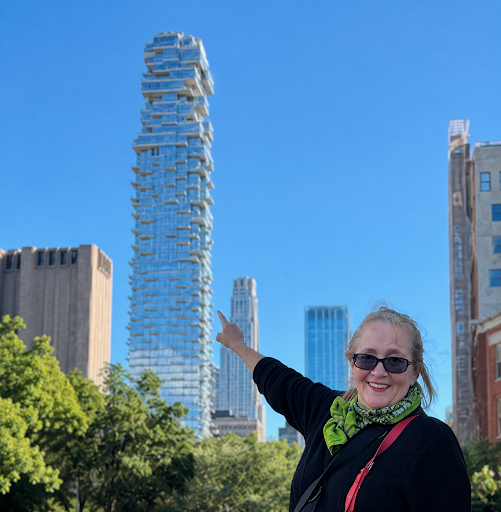
Here is the part that has stayed with me. The architects said they were tired of towers that felt anonymous and repetitive. Identical floors, stacked to the sky. So they did the harder thing. They designed this one from the inside out, as a collection of individual homes, and let the building's shape follow from what each one needed.
That is not just how you build a landmark.
It is how you build a team that lasts. And it is almost the exact opposite of how most design firms hire.
Anonymous and repetitive is the easy way to build, and the easy way to staff. Stack identical roles. Fill identical seats. Move on. Building from the inside out is slower, and it is the only thing I have seen actually work over 26 years of search.
Here is what it looks like in practice.
You are probably looking at the wrong floor
When firms tell me about the talent shortage, they mean new graduates or signature Design Directors. There are plenty of the first, and everyone is fighting over the same handful of the second.
The real gap is the middle. The eight-to-fifteen-year band. The senior Project Architects who actually run the jobs, manage the consultants, mentor the juniors, and hold the institutional knowledge that takes years to rebuild.
Most firms over-invest at the top and the bottom and quietly hollow out the middle. Then they wonder why delivery wobbles when one of those people walks. The firms still hitting their deadlines in 2027 are the ones staffing that floor now.
The best person for the role is not looking for it
The candidate you most want to hire this year is not on a job board. They are heads-down on a project they care about, at a firm that has not yet given them a reason to leave.
The active market shows you who is available. It rarely shows you who is good. Those two lists overlap far less than most firm leaders assume. Which is why posting a role and waiting is the slowest way to fill it. The people you actually want never see the ad.
Building from the inside out means you are in relationship with those people long before you have a seat for them.
They stopped choosing on money two years ago
When a senior designer takes a lower offer over yours, it is rarely about the number. It is about what the number came with.
The ones worth fighting for are weighing three things. A real client-ownership path, not just a seat on bigger projects. Genuine autonomy over how they run their studio. And a clear route to equity or partnership, written down, not implied.
Most job specs still lead with the project list and the package. That answers a question your best candidates are no longer asking. The offer that wins is the one that shows them their future, not their salary.
Speed is the quietest signal you send
Most firms lose their first-choice candidate in the gap between the final interview and the offer. Not on money. On time.
The panel goes brilliantly, everyone agrees she is the one, and then the firm takes nine days to align internally while she sits with a competing offer that landed the same afternoon. Senior talent reads delay as doubt. If you were not sure, why should she be.
Decide who signs off before the final interview. Agree the number before she walks in. To the right person, moving fast does not read as pushy. It reads as conviction.
The real answer always comes late
A candidate once told me, forty minutes into a call, that she did not want the job I was ringing about. Most recruiters would have wrapped up there. I almost did.
Instead I asked her what she did want. After a long pause, she described a role she had never seen advertised and assumed did not exist. It existed. A client had been trying to describe exactly that role for months. I placed her there six weeks later, and she is still there four years on.
If I had ended the call when she said no, none of it happens. The most important thing a candidate tells you is almost never the answer to the question you asked. It is the thing they say after, when you stay in the conversation longer than feels comfortable.
That is what building from the inside out actually requires. You cannot design a role around a person until you have genuinely heard them.
Back to the building
Herzog & de Meuron could have stacked identical floors and finished years sooner. They refused anonymous and repetitive, and the result is a building people stop on street corners to photograph.
The firms whose teams still feel like that in five years will be the ones who refused it too. In their hiring as much as their design.
If you are building a senior team this year, and you would rather build it from the inside out than from a template, that is the conversation I have every day. Let’s Chat
Best,
Nancy
Architecture. Interior Design. Landscape Architecture. That is what we do. That is all we do.