
The Most In-Demand Hire Right Now Is Not The One With The Best Portfolio
The Hires Nobody Puts in the Case Study
Welcome to the October 2026 edition of The NDH Perspective. After 26 years of placing design talent, I have noticed that the people firms compete hardest over are rarely the people whose work wins the awards.
In September I wrote that the most in-demand hire in Interior Design right now is the person who can get FF&E through procurement without the schedule collapsing. That post drew more conversation than anything else I shared in September or October, and the idea behind it reaches well beyond one discipline.
This edition follows that idea through four questions: what firms are paying for skills nobody sees, why good people leave, where a practice's knowledge really lives, and who is coming up behind today's leaders. I also share two events I attended this month.
For a confidential conversation about a search or a role you are planning, contact me directly at Nancy.Horne@ndhsearch.com.
THE HIDDEN-SKILL PREMIUM: WHY THE ROLES FIRMS COMPETE OVER ARE NOT THE ONES THEY SHOWCASE
Design talent is visible, so firms hire it confidently. Procurement talent is invisible until a fabric goes out of stock three weeks before install and the whole schedule moves. That gap between what is visible and what is valuable is where the market is tightest right now.
What Is Driving Demand
Procurement-strong Interior Designers are fielding several approaches at once. They are the profile I am asked for most often, and the hardest one to find.
Firms are creating standalone FF&E lead roles. The job is being separated from design roles and given its own title and its own outcomes.
Hospitality and multi-family projects are driving most of that demand. Neither forgives a missed install date.
The skill rarely appears in a portfolio. A search built only on portfolio review will pass over the very people firms are trying to reach.
The market reality: Firms are competing over people whose work never makes it into the case study.
Where I Would Start
Name the role. If your studio relies on someone to run FF&E, give that job its own title and its own outcomes in the job spec, so the right candidates recognise it as theirs.
Ask for the procurement story. In interviews, ask a candidate to walk you through a delivery that went wrong, what they did in the first 24 hours, and what they changed afterwards.
THE RETENTION QUESTION: WHY YOUR QUIETEST PERFORMERS ARE THE ONES BEING NOTICED
The people who keep a studio running are often the least visible, and competitors tend to know who they are before the firm's own leadership has said so.
What Keeps People, From What I See
A named mentor in the first two years. The strongest Project Architects I place almost always name one specific mentor who shaped their early career.
Recognition for work nobody photographs. If your studio has one person who quietly keeps every order on schedule, look after them before somebody else makes it their job to.
Leaders who own the project that went sideways. A title tells me very little about a leader. The way they talk about a project that went wrong tells me a great deal.
An honest answer to why the last person left. Candidates ask, and the answer is the clearest picture of a firm's retention story. [Nancy to confirm]
The opportunity: The cheapest retention step is the one most firms skip. Tell the person holding your projects together what you see in them, before another firm does. [Nancy to confirm]
Retention Moves to Make This Quarter
Write down what each person will own in year one. Outcomes, not a list of tasks, agreed with the person at the start.
Ask your quiet delivery lead what they want next. Do it before an outside call makes the question urgent.
Answer the last-departure question internally first. If the honest answer is uncomfortable, that is where to begin.
For a confidential conversation about keeping or building your team, contact me at Nancy.Horne@ndhsearch.com.
THE NEXT FRONTIER: PRACTICE KNOWLEDGE AS THE THING FIRMS CANNOT AFFORD TO LOSE
The strongest firms I speak with treat how they deliver as knowledge worth protecting, not only what they design. Most of that knowledge lives in people, which is why it is easy to lose and hard to replace.
What Practice Knowledge Looks Like
The delivery story. What someone did in the first 24 hours of a delivery that went wrong, and what they changed afterwards, is knowledge a practice can learn from.
One plan, many building types. The SCUP symposium this month looked at how a campus manages very different buildings within a single master plan. A practice faces the same task: shared principles that hold across very different projects.
Mentoring as transfer. Brian Goldstein's keynote on J. Max Bond Jr. showed how much of his career was about mentoring the next generation of architects.
First sketch to final walkthrough. The work depends on people who can carry a design the whole way, and that ability rarely appears on a CV.
From the Room: Two Events in October
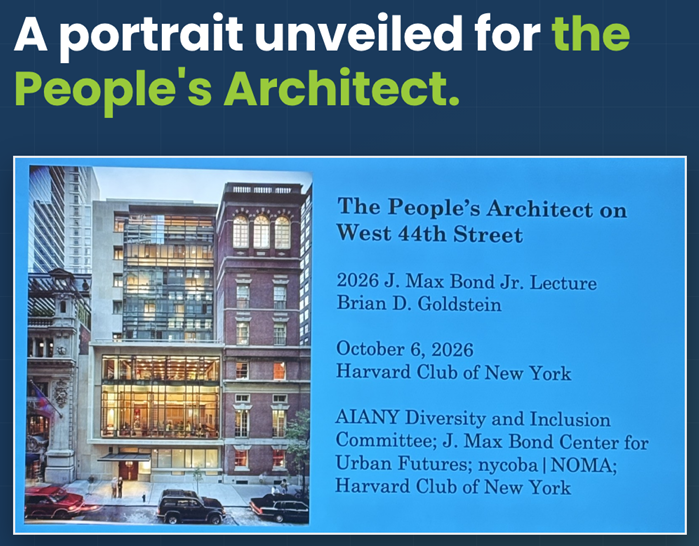
Harvard Club of New York, 6 October. I attended the 2026 J. Max Bond Jr. Lecture, where a portrait of the architect was unveiled. It is the first portrait commissioned for permanent display at a Harvard-affiliated institution. Bond was the lead architect on the Club's 2000 extension on West 44th Street, and seeing the original model, with his modern glass extension between the historic buildings on either side, was a reminder of how well he balanced new space with the character of what was already there.
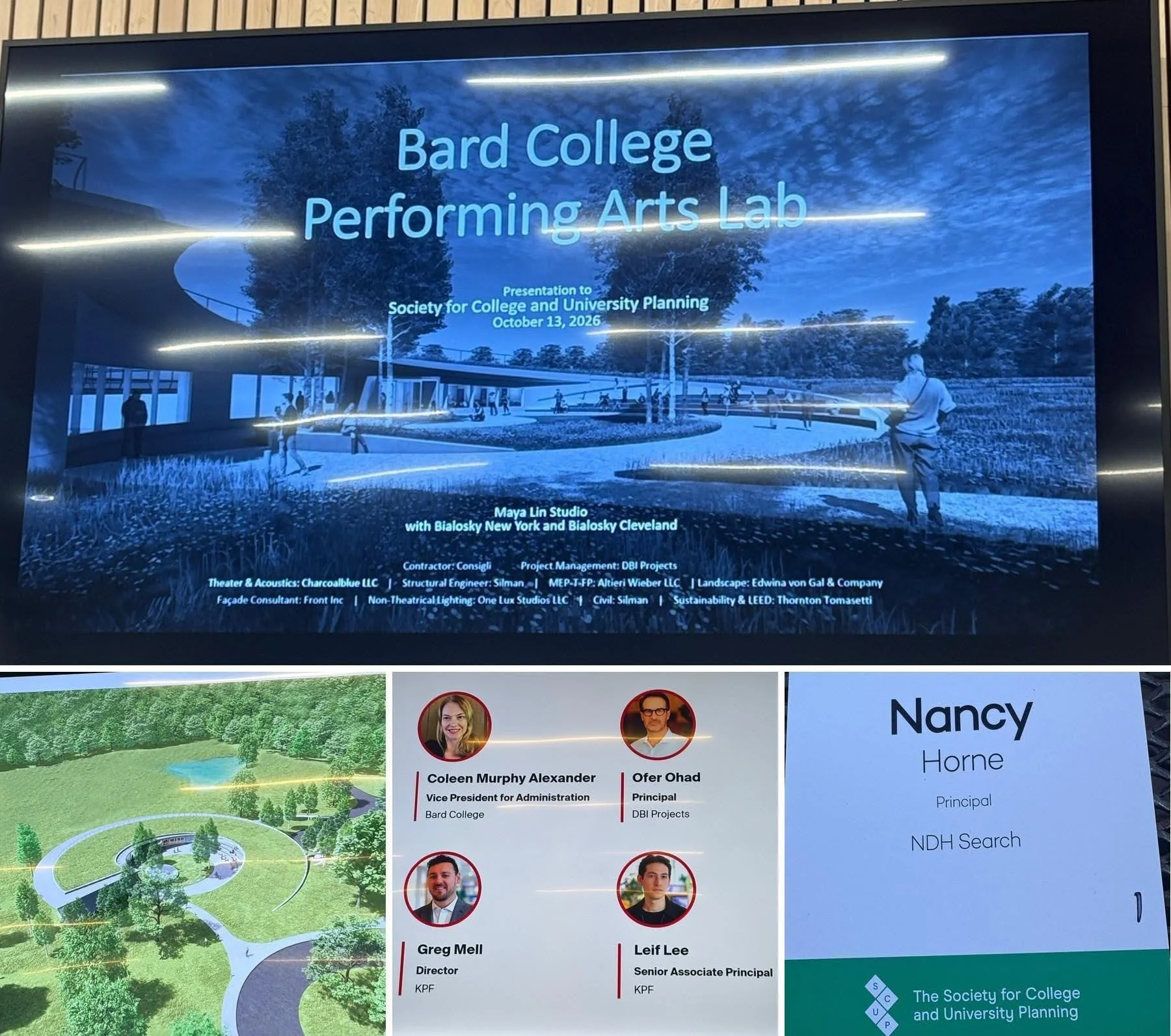
SCUP symposium at Bard College, 13 October. The day ran in three parts. The KPF team presented the North Campus Housing and Center they designed. Then the Maya Lin Studio team, with Bialosky New York and Bialosky Cleveland, presented the Bard College Performing Arts Lab, the new building for the Fisher Center at Bard, which opened in September. We finished with a tour of the North Campus Housing, the North Campus Center and the performing arts building.
The insight: The most valuable knowledge in a practice is the kind that is hardest to see, because it lives in how things get delivered. Higher education is one of the sectors I recruit in most, and days like these show what that work depends on.
THE GENERATIONAL HANDOFF: THE PIPELINE YOU BUILD NOW IS THE LEADERSHIP YOU HAVE IN FIVE YEARS
Senior talent is visible, so firms invest in it confidently. Junior development is invisible until five years later, when the pipeline of ready mid-level talent is simply not there.
What Is at Stake
Junior headcount is cut to protect senior budgets. Firms then struggle to backfill mid-level roles two years later.
The mentor effect is real. The strongest Project Architects I place almost always name one specific mentor who shaped their first two years.
Development looks like a cost while it is happening. Its value only shows later, which is why it is the first thing to be trimmed.
What Works
Name a mentor for every junior hire. Make it a defined relationship for the first two years, not an accident of who sits nearby.
Protect junior headcount when you protect senior budgets. The mid-level talent you will need later comes from the people you hire now.
Ask each year who is ready to step up. Name who could move into a larger role within two years, and who needs support to get there.
The insight: Twenty-six years in, the pattern has not changed. The firms with the strongest talent pipelines today are the ones that took junior development seriously five years ago, when it looked like a cost rather than an investment.
THE MARKET CHECK: IS MIDDLE EAST HIRING ON HOLD?
I recently put one of our Middle East searches on hold. Security events across the Gulf this year have made it hard to ask candidates and clients to commit to timelines, and I am curious whether others in our industry are feeling the same.
I would value a read on the market from Architecture, Interior Design and Landscape Architecture firm leaders. This week's LinkedIn polls ask two questions. The first:
Is your firm currently recruiting for clients in the Middle East and North Africa?
1. Yes, actively hiring
2. Yes, but more selectively
3. On hold for now
4. Not recruiting there
Drop me a DM on your thoughts. If your answer is "it depends", tell me what it depends on in the comments.
The second poll looks at the candidate side. The Middle East has been one of the biggest sources of senior design opportunities for years, from master planning to hospitality and cultural work. But relocating a family is a very different decision from taking a call about a role.
For those of you who talk to senior designers and architects regularly, I would like to know what you are hearing, and whether people are still open to a move from the West or the conversation has changed.
Are senior design professionals in the West still open to relocating to the Middle East?
1. Yes, still open
2. Only with conditions
3. Less open than before
4. Not at all
DM me and share what is driving your answer if you can. I’ll share the results of my linkedin polls with you all soon too.
LOOKING AHEAD: WHAT TO START BEFORE 2027
Several threads from this edition are worth tracking as the year closes:
Senior hires you know are coming next year. The people you want are rarely looking, so the conversation should start now, not when the seat is officially open.
Standalone FF&E lead roles. Watch whether more firms separate this job from design roles and give it its own title and outcomes.
Hospitality and multi-family projects. Both depend on procurement skill, because neither forgives a missed install date.
Higher education and campus work. It remains one of the sectors I recruit in most, and it rewards people who can carry a design from first sketch to final walkthrough.
The firms that start 2027 strongly are the ones that spend October and November building relationships.
If a search is on your horizon, I am glad to talk it through. Contact me at Nancy.Horne@ndhsearch.com.
Next Edition: November 2026. "The Hiring Playbook: Five Questions to Answer Before You Open a Senior Search."
Nancy Horne, Principal, NDH Search Worldwide, Los Angeles and New York. www.ndhsearch.com
© 2026 NDH Search. All rights reserved.